
Board reporting software that assembles the pack from your books
Board reporting software collects the financial results, cash position, KPIs and forecast your board reviews and formats them into one consistent pack. Budgeter.ai builds that pack from synced QuickBooks or Xero data and your live forecast, drafts the narrative for you to edit, and exports it as PDF or slide-ready files.
Read-only connections. Encrypted data. Cancel anytime.
Cash
$3.10M
Runway
21 mo
ARR
$6.1M
Gross margin
74%
Scroll sideways for all columns
| Q3 2026 | Budget | Actual | Var % |
|---|---|---|---|
| Revenue | $1,520k | $1,488k | -2.1% |
| Gross profit | $1,125k | $1,101k | -2.1% |
| Operating expenses | $1,610k | $1,544k | -4.1% |
| Net burn | $485k | $443k | -8.7% |
| Headcount | 58 | 55 | 3 open roles |
Summary
Revenue landed 2.1 percent under plan after two enterprise renewals moved to October. Lower hiring kept burn 8.7 percent below budget, extending runway by one month.
Example figures inside the product interface.
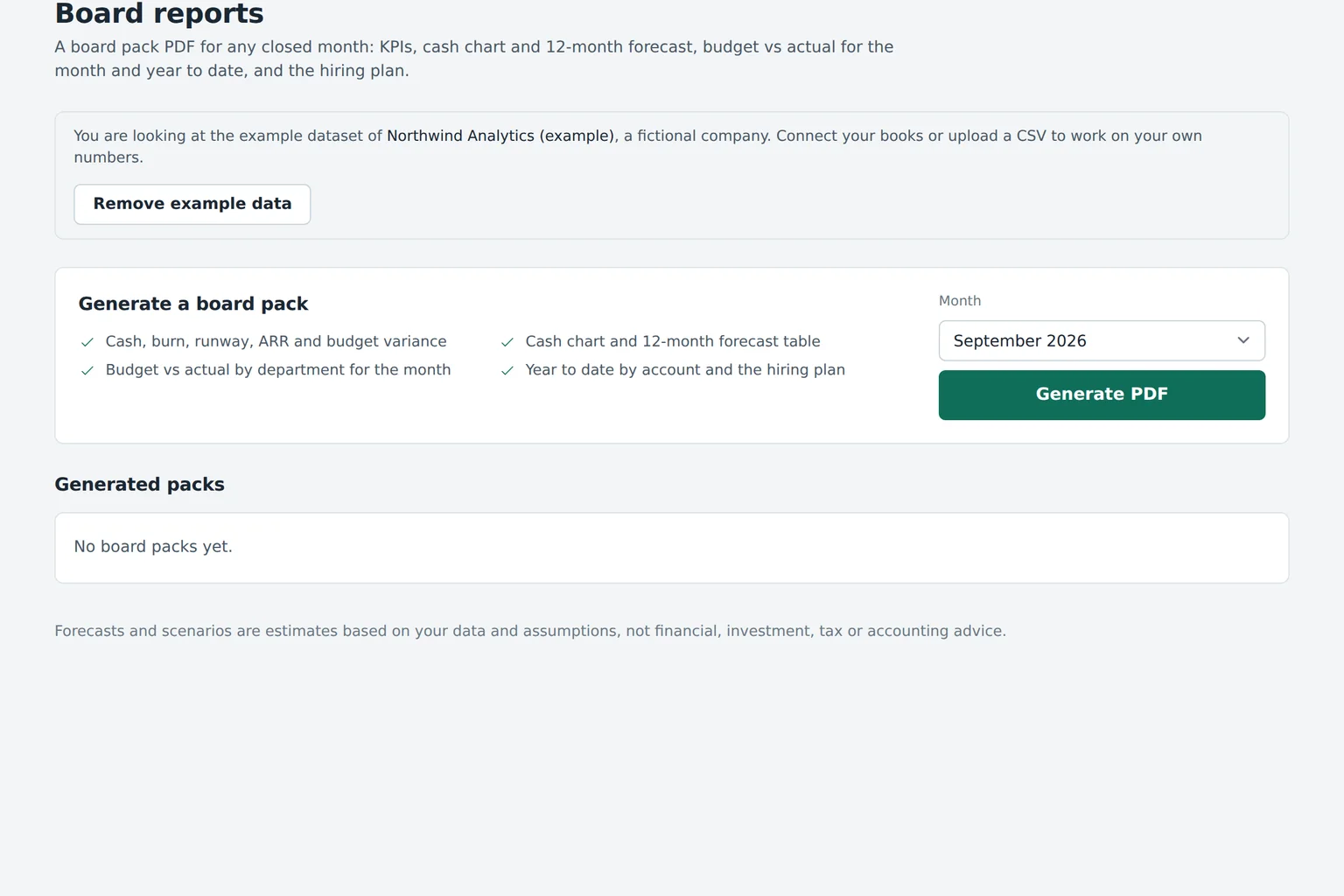
What a good board pack contains
Boards do not want more data. They want the same few numbers every time, in the same order, with an honest sentence on what changed.
P&L against budget
Revenue, gross profit, operating expenses by function and net result, each with budget, actual and variance for the period and year to date.
Cash and runway
Closing cash, net burn, months of runway at current burn and at planned burn, and the month cash would run out if nothing changed.
KPIs
Five to eight metrics the board agreed on, such as ARR, gross margin, net revenue retention and CAC payback, with target and trend.
Headcount
People by department against plan, open roles, planned start dates and the effect of hiring delays on cost.
Updated forecast
The rest of the year and the next twelve months, with the main assumption changes since the last meeting listed plainly.
Narrative and asks
One page in plain language: what went well, what did not, what the team will do and which decisions it needs from the board.
Each section is a view that already exists in Budgeter. The P&L page is the same budget vs actual report your team uses monthly, the headcount page comes from headcount planning software, and the KPI page uses the definitions you set once in your KPI dashboards. The pack is an arrangement of numbers you already trust, not a second set of figures.
Why board packs take a week
In most companies under a few hundred people, the board pack is built by the CEO or the head of finance in the week after close. Actuals come out of the accounting system, the model is updated in a spreadsheet, charts are pasted into slides, and the numbers are checked against last quarter's deck by eye. A single late journal entry can mean redoing half of it.
The time is not spent on thinking. It is spent on moving numbers between files and then making sure the move did not break anything. That is the part that software should do, and it is the part where mistakes reach the board: a chart that did not refresh, a runway figure from the old forecast, a headcount table that disagrees with the P&L by one person.
What changes with Budgeter
Every figure in the pack is a live reference to the same data, so the cash on page two and the runway on page five cannot disagree. When actuals sync after a late adjustment, the pack updates and shows which figures moved. You review the changes instead of hunting for them.
The narrative starts as a draft. The AI CFO reads the variances, the forecast changes and the KPI movements and writes a short summary in plain English. It is a starting point you rewrite in your own voice, and it saves the blank page, which is often the slowest part of the job.
How it works
The pack is built once as a template and then refreshed each period.
-
01
Pick the period and template
Choose a monthly or quarterly pack and the sections your board expects. The template is saved, so every pack has the same order.
-
02
Let the numbers fill in
P&L vs budget, cash, runway, KPIs and headcount come from synced actuals and your current forecast, with no copy and paste.
-
03
Write the narrative
The AI CFO drafts a short summary of what changed and why. You edit it until it says what you would say in the room.
-
04
Export and lock
Export to PDF or a slide-ready file. The pack is stored with its figures, so next quarter you can compare against what you actually sent.
Monthly or quarterly board reporting
Cadence depends on stage, investors and how fast the business changes. The table shows common patterns, not rules.
Scroll sideways for all columns
| Company situation | Typical cadence | What goes out | Budgeter setup |
|---|---|---|---|
| Seed to Series A, under 18 months of runway | Monthly update, quarterly meeting | One page of cash, burn, runway and top KPIs each month | Short monthly template plus full quarterly pack |
| Series B, stable runway | Quarterly meeting, monthly cash note | Full pack each quarter, cash note in between | Quarterly template, monthly cash export |
| Profitable company with outside investors | Quarterly | P&L vs budget, cash, forecast, key decisions | Quarterly pack with year to date focus |
| Multiple entities | Quarterly, per entity and consolidated | Group summary plus entity pages | Scale plan, consolidation across up to 5 entities |
Whatever the rhythm, keep the template stable. Directors read packs side by side over time, and a changed layout costs them more effort than a slightly imperfect one. If you move a metric or change a definition, say so on the summary page.
Consistency between versions
The fastest way to lose a board's confidence is a number that changes between meetings without an explanation.
- Every exported pack is stored With the exact figures it contained, so you can open what the board saw in March at any time.
- Restatements are flagged If a closed month changes after a late entry, the next pack lists the prior figure, the new figure and the difference.
- Forecast versions are named Runway in the pack always points to a named forecast version, so you know which assumptions it used.
- KPI definitions are fixed A metric uses the same formula every quarter. Changing it creates a new version with a note.
- Access is controlled Board members can be read-only viewers of the pack without seeing the ledger or payroll detail.
Ways to produce a board pack
An honest look at the options, by who does the work and what it costs.
Scroll sideways for all columns
| Option | Who does the work | Typical cost | Main limitation |
|---|---|---|---|
| Spreadsheet and slides | CEO or finance lead | Their time each period | Manual updates, version errors |
| Fractional CFO | An outside finance professional | $3,000 to $10,000 a month | Cost, and the pack waits on their schedule |
| Reporting tools for accountants | Accountant or bookkeeper | For example Fathom, $67 to $450 a month | Strong on reporting, lighter on forecasting |
| FP&A platform | Finance team after implementation | Jirav $10,000 to $15,000 a year, others by demo | Sales cycle and setup project |
| Budgeter.ai Growth | Finance lead with AI CFO drafts | $599 a month or $299 billed yearly | One entity, multi-entity on Scale |
For founders who also own the model and the fundraise, our page on FP&A software for startups covers the wider planning setup. All plan prices are on the pricing page.
Forecasts and scenarios are estimates based on your data and assumptions, not financial, investment, tax or accounting advice.
Questions about board reporting
Board packs are part of Growth, Scale and Enterprise.
What goes into a board pack?
A typical pack has a one page summary, the P&L against budget, cash position and runway, a small set of KPIs, headcount against plan, the updated forecast and a list of decisions the board is asked to make. Budgeter builds each of these from your data.
Can I export the board pack to slides?
Yes. On Growth, Scale and Enterprise the pack exports as a PDF and as a slide-ready file you can open in Google Slides and restyle with your own template. Exports also include CSV and XLSX for the underlying tables.
Should board reporting be monthly or quarterly?
Many early stage companies send a short monthly update and hold a full board meeting every quarter. Later stage companies often report quarterly with a monthly cash note. Budgeter supports both from the same template.
How does Budgeter keep figures consistent between packs?
Each exported pack is stored with the numbers it contained. If a prior month is restated after a late journal entry, the next pack shows the change against the version you sent, so nobody discovers it by comparing PDFs.
Is the AI summary sent without review?
No. The narrative is a draft for you to edit. It cites the figures it used, and nothing leaves Budgeter until you export or share the pack yourself.
Which plan includes board reporting?
The board pack is part of Growth at $599 a month or $299 billed yearly, and of Scale and Enterprise. Small Business includes PDF and CSV exports of individual reports but not the assembled pack.
Send the board the same numbers you run the company on
Start with a runway forecast from a few numbers, then connect your books and build a board pack template you reuse every period.
Forecasts and scenarios are estimates based on your data and assumptions, not financial, investment, tax or accounting advice.