
Cash flow forecasting software with runway you can trust
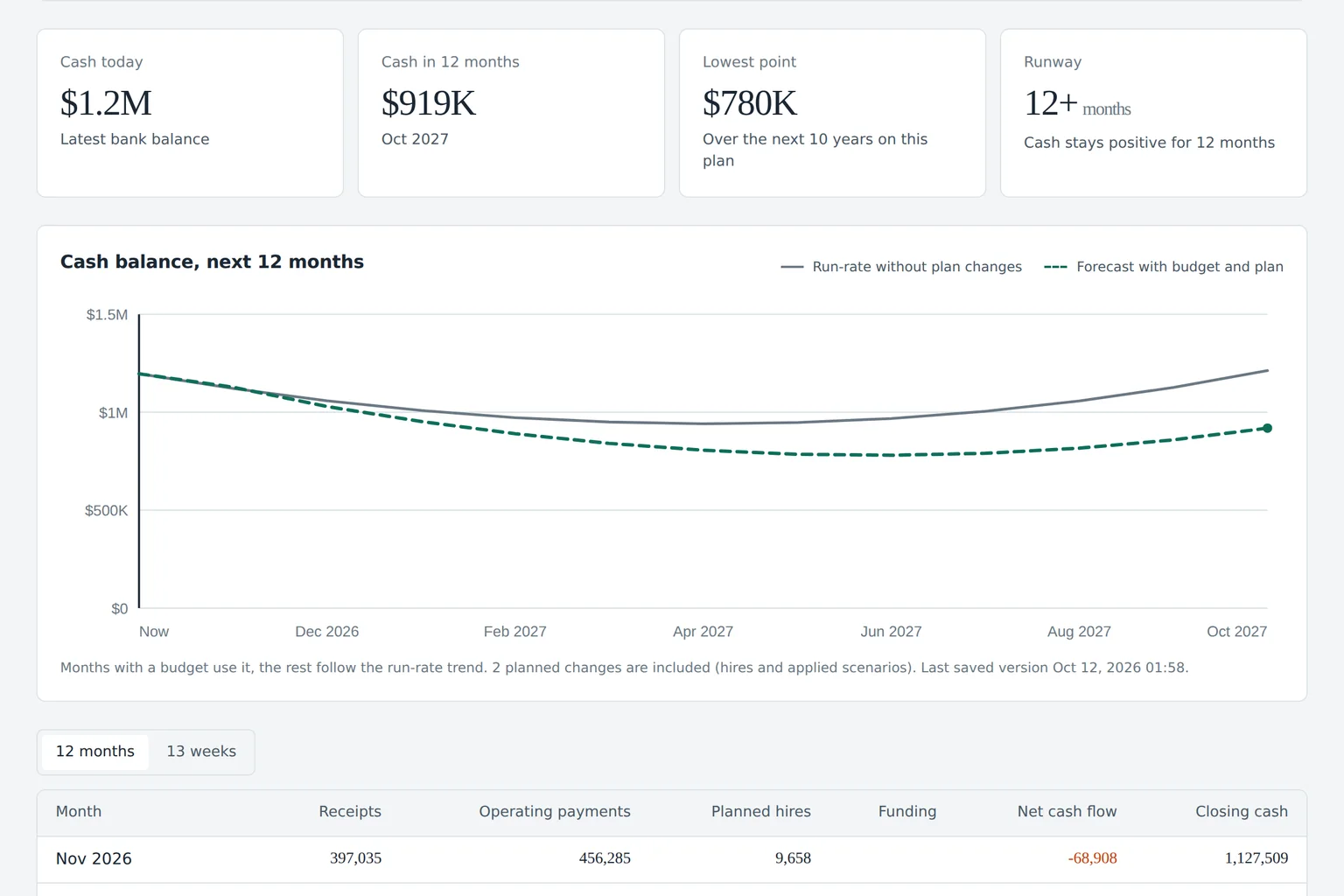
Cash flow forecasting software projects the cash you will receive and pay week by week and month by month, so you know your runway before the bank balance tells you. Budgeter.ai builds a 13-week and 12-month cash forecast from your books, bank feed and open invoices, and refreshes it on every sync.
Read-only connections. Encrypted data. Cancel anytime.
Runway
11.4 months
Cash-out month
Aug 2027
Lowest week
$612k
| Thousands USD | W1 | W2 | W3 | W4 | W5 | W6 | W7 |
|---|---|---|---|---|---|---|---|
| Opening cash | 842 | 868 | 751 | 779 | 806 | 664 | 690 |
| Customer receipts | 96 | 54 | 88 | 91 | 62 | 97 | 58 |
| Payroll | 0 | -148 | 0 | 0 | -152 | 0 | 0 |
| Suppliers and software | -52 | -19 | -44 | -48 | -21 | -55 | -24 |
| Rent and taxes | -18 | -4 | -16 | -16 | -31 | -16 | -3 |
| Closing cash | 868 | 751 | 779 | 806 | 664 | 690 | 721 |
Runway alert set at 9 months. Current forecast is above the threshold.
Example figures inside the product interface.
Why profit and cash tell different stories
A company can be profitable on paper and still miss payroll. Revenue is booked when you invoice, but cash arrives when the customer pays, sometimes 45 or 60 days later. Annual software contracts paid upfront do the opposite and fill the bank account long before the revenue is earned. Payroll, rent and tax payments do not wait for either.
That timing gap is what a cash flow forecast is for. Your budget tells you whether the year makes money. The cash forecast tells you whether you can pay every bill on the way there, and how many months you have left if growth or fundraising takes longer than planned.
Most finance leads keep two views. The 13-week forecast is operational and built from real invoices and bills. The 12-month forecast is strategic and built from the operating plan you maintain in your budgeting and forecasting model. Budgeter keeps both in one place, so they never contradict each other.
The 13-week view and the 12-month view
Each horizon answers a different question, so they use different inputs and a different method.
Scroll sideways for all columns
| 13-week cash forecast | 12-month cash forecast | |
|---|---|---|
| Question it answers | Can we pay everything due this quarter? | How long does the cash last and when do we need more? |
| Granularity | Weekly | Monthly |
| Main method | Direct, receipts and payments line by line | Indirect, operating forecast adjusted for timing |
| Key inputs | Bank balance, open invoices, open bills, payroll calendar | Revenue plan, hiring plan, cost budget, collection terms |
| Typical decision | Delay a supplier payment, chase two invoices | Raise now or in six months, hire or wait |
| How often it changes | Every sync, as invoices are paid | Every sync, as actuals replace estimates |
The direct method in practice
The direct method is a list of expected cash movements. A customer invoice of 24,000 dollars due on the 15th becomes a receipt in that week, adjusted by how late that customer usually pays. A supplier bill becomes a payment on its due date. Payroll appears on its run dates. It is precise because every number points to a document, and that is also why it runs out of detail after a few months.
The indirect method in practice
The indirect method starts from forecast operating profit, adds back non-cash items such as depreciation and adjusts for changes in receivables, payables and deferred revenue. It does not need individual invoices, so it can look a year or more ahead. Budgeter switches from direct to indirect where the known documents end, so the two horizons join without a gap.
How Budgeter builds the cash forecast
Setup takes one session. After that, the forecast follows your books and bank without exports.
-
01
Start from the bank balance
The bank feed or your latest reconciled balance sets the opening cash, so the forecast begins from money you actually have.
-
02
Add timing to receivables and payables
Open invoices and bills from QuickBooks or Xero are placed in the week they are likely to clear, based on due dates and how each customer has paid before.
-
03
Layer in recurring flows
Payroll runs, rent, subscriptions, tax payments and expected new sales fill the weeks and months that have no invoice yet.
-
04
Watch runway and act early
Budgeter calculates runway and the cash-out month and sends an alert when runway drops below the threshold you set.
Timing is where cash forecasts usually go wrong. An invoice due in 30 days from a customer who always pays in 52 should not sit in week four. Budgeter looks at the payment history behind each customer and supplier in your accounting data and places expected receipts and payments where they are likely to land, not where the terms say they should.
Revenue that has no invoice yet comes from your plan. On Growth and higher, recurring revenue from Stripe as your own data source and pipeline from your CRM feed the revenue planning software module, and the result flows straight into expected receipts. Planned hires from headcount planning appear as payroll from their start date.
Runway alerts work on thresholds you choose. Set the alert at nine months, and when the rebuilt forecast shows runway falling below that line, the right people get an email with the cash-out month and the main lines that moved. You hear about it while there is still time to cut, collect or raise.
Every number can be questioned. Ask the AI CFO why the lowest week moved from 640,000 to 612,000 dollars, and it lists the invoices and payments behind the change. Ask how much cash you need to reach break-even plus six months of buffer, and it answers from the same forecast.
A worked runway example
Consider a hypothetical 28 person software company with 1.9 million dollars in the bank, 210,000 dollars of monthly revenue growing 3 percent a month and 340,000 dollars of monthly costs.
A simple average says 1.9 million divided by 130,000 of burn equals about 14.6 months. The month by month forecast tells a different story once you add real timing and planned decisions.
Forecasts and scenarios are estimates based on your data and assumptions, not financial, investment, tax or accounting advice.
Scroll sideways for all columns
| Assumption | Runway | Cash-out month | Read |
|---|---|---|---|
| Average burn, no growth | 14.6 mo | Dec 2027 | Too simple |
| Growth, annual prepayments in January | 19.2 mo | May 2028 | Base case |
| Base case plus 4 sales hires in Q1 | 13.1 mo | Nov 2027 | Needs a raise plan |
Growth and prepayments extend the runway well beyond the average. Four sales hires in the first quarter, at roughly 140,000 dollars of loaded annual cost each, pull it back to about 13 months before their pipeline produces revenue. That is the trade-off the leadership team has to see before signing offers, and it is what scenario planning software is for.
Cash forecasting options compared
You can forecast cash in many places. The difference is how much of the work stays manual.
Scroll sideways for all columns
| Need | Spreadsheet | Accounting software | Demo-led FP&A suites | Budgeter.ai |
|---|---|---|---|---|
| Opening balance | Typed in | From the ledger | Connected | Bank feed or ledger |
| Invoice timing | Due dates only | Due dates only | Varies by vendor | Due dates adjusted by payment history |
| 13-week and 12-month | Two models to maintain | Short-term view at best | Usually yes | Both, joined in one model |
| Runway and cash-out month | Formula you maintain | No | Yes | Yes, with alerts |
| Price | Your time | Included in subscription | Quote after a demo | From 149 USD a month |
Accounting software knows your invoices but rarely projects beyond them. A spreadsheet can do anything, as long as someone rebuilds it every week. Mid-market platforms such as Datarails, Cube and Abacum share prices only after a demo, while reporting tools like Fathom, at 67 to 450 dollars a month, focus on reporting and budget vs actual more than on modeling. Budgeter includes the 13-week and 12-month cash forecast in every plan, listed on the pricing page.
Signs your cash forecast needs work
If any of these sound familiar, the forecast is giving you comfort rather than warning.
- The forecast is updated only before board meetings Cash moves daily. A quarterly snapshot misses the week where payroll and a tax payment fall together.
- Runway is one number, burn divided into cash Average burn hides growth, seasonality, prepayments and planned hires, which together can move runway by many months.
- Receipts are placed on the invoice due date Customers pay on their habits, not your terms. Use the history you already have in the ledger.
- Nobody compares last month's forecast with what happened Without that check you never learn whether the forecast is biased. See how in forecast vs actual variance analysis.
- The 12-month view ignores the hiring plan Offers signed this quarter are next quarter's payroll. They belong in the forecast the day they are approved.
Questions about cash flow forecasting
The 13-week and 12-month cash forecast is included from the Small Business plan up.
What is a 13-week cash flow forecast?
It is a week by week projection of cash receipts and payments for the next quarter, starting from today's bank balance. Thirteen weeks is long enough to see a payroll crunch or a large tax payment coming and short enough to forecast from real invoices and bills.
What is the difference between the direct and indirect method?
The direct method lists the cash you expect to receive and pay, line by line, and suits short horizons. The indirect method starts from forecast profit and adjusts for non-cash items and working capital, and suits longer horizons where individual invoices are not known yet.
How is runway calculated?
Runway is the number of months until the cash balance would fall below zero if the forecast plays out. Budgeter reads it from the 12-month forecast month by month, so it reflects growth, planned hires and timing rather than a single average burn figure.
Do I need a bank feed connection?
No. Budgeter can start from the cash balance in your accounting system. A bank feed keeps the opening balance current between closes, which makes the first weeks of the 13-week view more precise.
Can I try a cash forecast before choosing a plan?
Yes, once. The runway calculator takes a few numbers such as revenue, costs, cash in bank and hiring plans and returns an 18-month runway, cash-out month and break-even. The full forecast from your books is part of every paid plan.
Related planning modules
Know your runway before the bank does
Run the free runway calculator once on your own numbers, then connect your books for a 13-week and 12-month cash forecast that updates itself.
Forecasts and scenarios are estimates based on your data and assumptions, not financial, investment, tax or accounting advice.