
Revenue planning software built on MRR, pipeline and sales capacity
Revenue planning software forecasts future revenue from its real drivers instead of a growth percentage. Budgeter.ai reads MRR from Stripe split into new, expansion and churn, weights CRM pipeline by stage probability, checks it against sales capacity and ramp, and links the plan to headcount, cash and runway.
Read-only connections. Encrypted data. Cancel anytime.
Scroll sideways for all columns
| Month | Start | New | Expansion | Churn | End |
|---|---|---|---|---|---|
| April | $180,000 | +$14,200 | +$5,600 | -$4,100 | $195,700 |
| May | $195,700 | +$15,800 | +$6,100 | -$4,900 | $212,700 |
| June | $212,700 | +$13,900 | +$7,200 | -$5,300 | $228,500 |
| July | $228,500 | +$17,400 | +$6,800 | -$6,000 | $246,700 |
| August | $246,700 | +$16,100 | +$8,300 | -$5,700 | $265,400 |
| September | $265,400 | +$18,600 | +$7,900 | -$6,400 | $285,500 |
Ending ARR
$3.43M
September MRR times 12
Net new MRR in September
+$20,100
Churn 2.4% of starting MRR
Example figures inside the product interface.
Why a growth percentage is not a revenue plan
The quickest revenue forecast is last month times one plus a growth rate. It is also the least useful, because it cannot tell you why the number moves. When growth slows, you do not know whether fewer deals closed, existing customers stopped expanding or churn crept up. Each of those needs a different response, and a single percentage hides all three.
A driver based plan breaks revenue into the parts you can actually influence. For a subscription business those parts are new customers, expansion from existing customers and churn. For each part you can name an owner, a source of data and an assumption that someone can defend in a board meeting. When the month closes, you can see which assumption held and which did not.
The plan also has to agree with the people who deliver it. A target of 40,000 dollars of new MRR per month means nothing if your sales team can only carry 25,000. Linking revenue to sales capacity, and capacity to the headcount planning software view of who you will hire and when, turns a wish into a plan with a cost attached.
Turning CRM pipeline into a forecast
Open deals in the CRM are not revenue yet. Weighting each stage by the share of deals that historically close turns a hopeful total into an expected one.
Scroll sideways for all columns
| Stage | Open deals | Pipeline value | Stage probability | Weighted value |
|---|---|---|---|---|
| Discovery | 48 | $1,200,000 | 10% | $120,000 |
| Evaluation | 26 | $800,000 | 25% | $200,000 |
| Proposal | 12 | $450,000 | 50% | $225,000 |
| Negotiation | 6 | $260,000 | 75% | $195,000 |
| Total | 92 | $2,710,000 | 27% | $740,000 |
The headline pipeline of 2.71 million dollars looks comfortable. The weighted value of 740,000 dollars is what the quarter can reasonably expect. Budgeter calculates stage probabilities from your own closed won and closed lost history in the CRM, rather than from default percentages, and you can override any stage if your process has changed.
Close dates matter as much as probabilities. A deal expected in the last week of the quarter has a real chance of slipping into the next one, and a slip moves revenue, commission and cash together. The plan uses expected close dates and spreads recognized revenue from the contract start, not the signing date.
Checking pipeline against sales capacity
Scroll sideways for all columns
| Reps | Count | Quota this quarter | Capacity |
|---|---|---|---|
| Fully ramped | 4 | $90,000 each | $360,000 |
| Month 2 of 4 ramp | 2 | $45,000 each | $90,000 |
| Starting next month | 1 | $22,500 | $22,500 |
| Team capacity | 7 | $472,500 |
Capacity here is new annual contract value the team can close in the quarter. If the weighted pipeline of 740,000 dollars is above capacity, the forecast is limited by people, not demand, and the plan caps it at what the team can close.
Bookings, revenue and cash are three different numbers
Founders often report bookings, accountants report revenue and the bank only knows cash. A revenue plan needs all three, kept apart.
Scroll sideways for all columns
| Month | Bookings | Recognized revenue | Cash collected |
|---|---|---|---|
| March | $60,000 | $5,000 | $0 |
| April | $0 | $5,000 | $60,000 |
| May | $0 | $5,000 | $0 |
| June to February | $0 | $45,000 | $0 |
| Contract year | $60,000 | $60,000 | $60,000 |
Bookings drive sales targets
Quota, commission and pipeline coverage are measured in bookings. They tell you how well the sales team is doing this quarter, but they say little about the profit and loss.
Revenue drives the income statement
Recognized revenue follows delivery. It is what your accounting system reports and what KPI dashboards use for gross margin, ARR and growth rates.
Cash drives runway
Cash arrives on billing terms, here 30 days after an upfront invoice. Annual prepayments can carry a company through a lean quarter, which is why the plan keeps billing terms per contract type.
How revenue planning works in Budgeter
Revenue planning in Budgeter starts from data you already have and ends in the cash forecast your board reads.
-
01
Connect revenue sources
Link Stripe as your own revenue data source and your CRM with read-only access. Budgeter reads subscriptions, invoices, deals and stages.
-
02
Build the MRR bridge
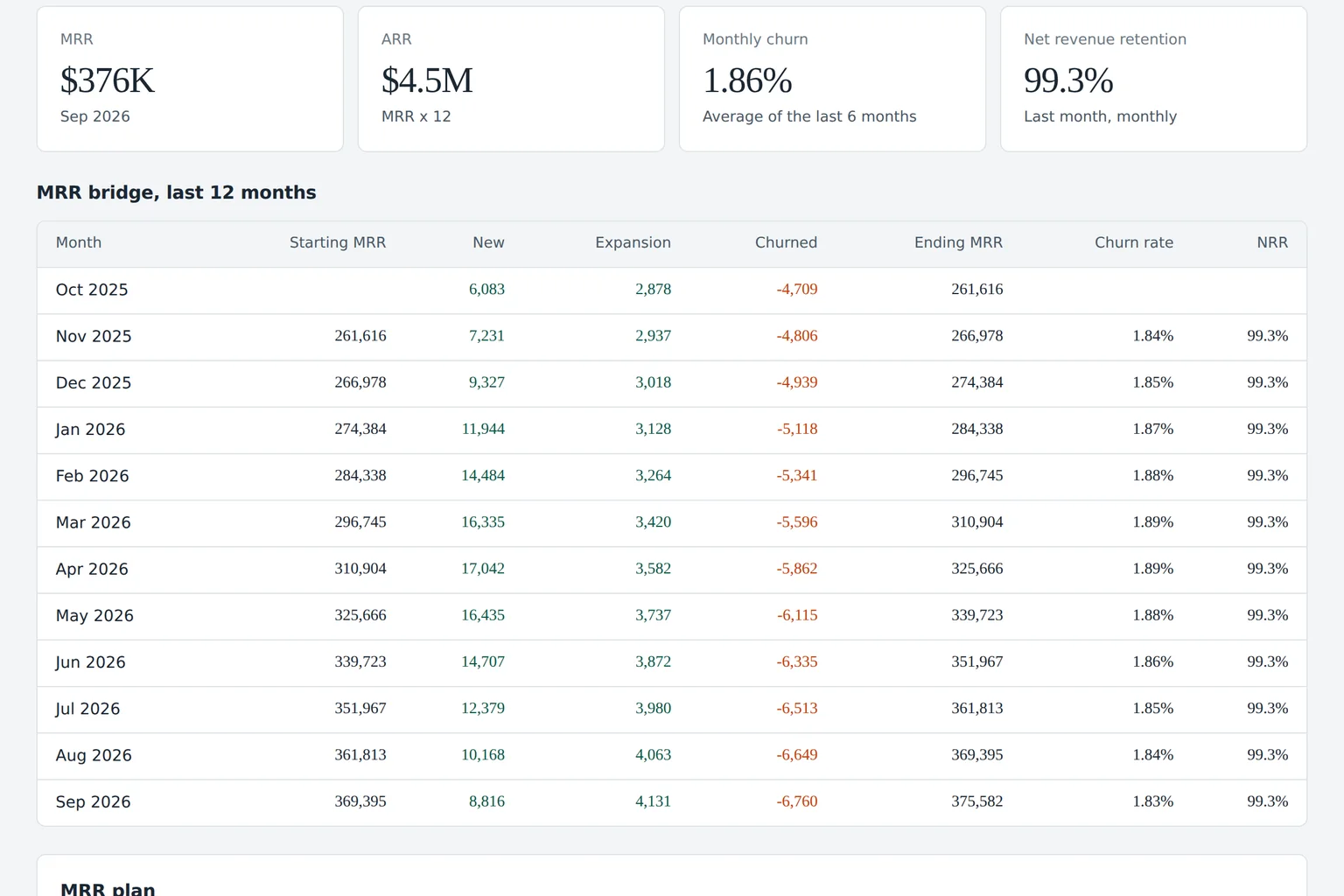
History is split into new, expansion and churned MRR by month, which becomes the starting point and the trend for each driver.
-
03
Weight the pipeline
Open deals are weighted by stage probability and expected close date, then checked against the capacity of your ramped sales reps.
-
04
Link to cost and cash
The revenue plan feeds the headcount plan, the cash forecast and runway, so every growth target shows what it takes to fund it.
Stripe and your CRM are connected with read-only access. Budgeter never creates charges, edits subscriptions or moves deals. It reads the history to build the MRR bridge and the pipeline weights, then refreshes on every sync so the plan reflects last night, not last quarter.
Each driver has its own assumption you can adjust: win rate per stage, average contract value, expansion rate, monthly churn, rep quota and ramp months. Change one and every dependent month moves, including commission cost and collections in your cash flow forecast.
Revenue and headcount plans are linked both ways. Adding two account executives raises capacity after their ramp and adds their loaded cost from day one. Raising the new MRR target shows how many reps you would need and when they would have to start, which is often the most useful number in an annual planning meeting.
The AI CFO answers questions such as what churn rate would push break-even out by a quarter, or how much ARR you can reach by December with the current team. Answers show the drivers behind them, and they flow into the board reporting pack as plain sentences.
Spreadsheet vs CRM forecast vs Budgeter
Revenue can be planned in many places. What matters is whether the plan stays connected to cost and cash after the first week.
Scroll sideways for all columns
| Need | Spreadsheet | CRM forecast | Enterprise FP&A suite | Budgeter.ai |
|---|---|---|---|---|
| MRR split into new, expansion and churn | Exports and formulas | No | Yes, after setup | Read from Stripe automatically |
| Pipeline by stage probability | Manual copy | Yes | Yes | Weights from your own win history |
| Sales capacity and ramp | Separate tab | Rarely | Yes | Linked to the headcount plan |
| Bookings vs revenue vs cash | Possible, fragile | Bookings only | Yes | All three per contract |
| Effect on runway | Another model | No | Yes | Updates instantly |
| Typical price | Your time | Part of the CRM | 10,000 to 150,000 dollars a year | From 599 dollars a month on Growth |
A CRM forecast is the right tool for running a sales team week to week. It looks at deals, not at recurring revenue already on the books, churn, or the cost of the people closing those deals. A spreadsheet can join everything together, but it has to be rebuilt by hand after every export, and one broken link makes the whole plan unreliable.
Enterprise FP&A platforms handle driver based revenue well and usually cost 10,000 to 150,000 dollars a year, with prices often given only after a demo. Jirav, for example, lists business plans at 10,000 to 15,000 dollars a year. Budgeter lists every plan on the pricing page.
Forecasts and scenarios are estimates based on your data and assumptions, not financial, investment, tax or accounting advice.
Questions about revenue planning
Revenue planning is included in Growth, Scale and Enterprise, together with the CRM and Stripe connections it uses.
What is revenue planning software?
It is a tool that builds your future revenue from its drivers rather than from a single growth percentage. For subscription businesses that means starting MRR, new, expansion and churn, plus open pipeline and sales capacity. The plan then feeds costs, cash and runway.
What is an MRR bridge?
An MRR bridge, sometimes called an MRR waterfall, starts with monthly recurring revenue at the beginning of a period, adds new and expansion MRR, subtracts churned and contracted MRR, and arrives at ending MRR. It shows where growth came from and where it leaked.
What is the difference between bookings and revenue?
A booking is the value of a contract when it is signed. Revenue is recognized as you deliver the service over the contract term. Cash depends on billing terms. A 60,000 dollar annual contract paid upfront is 60,000 dollars of bookings and cash in one month, but 5,000 dollars of revenue each month.
Can Budgeter plan revenue for a business that is not SaaS?
Yes. Services and project businesses plan revenue from pipeline, win rates, delivery capacity and billing schedules, and e-commerce businesses from orders and average order value. The MRR bridge is simply most useful when revenue is recurring.
Which plan includes revenue planning?
Revenue planning, with the CRM and Stripe integrations, is part of the Growth plan and above. Growth costs 599 dollars a month, or 299 dollars a month billed yearly, and includes headcount planning as well.
Build a revenue plan your team can deliver
Start with a runway forecast from your current revenue and growth, then connect Stripe and your CRM for a full MRR bridge and pipeline plan.
Forecasts and scenarios are estimates based on your data and assumptions, not financial, investment, tax or accounting advice.