
FP&A software for growing companies
FP&A software is a planning platform that connects to your accounting, bank, payroll and revenue data and runs budgeting, forecasting, cash flow, scenarios and variance analysis in one model. Budgeter.ai gives companies of 5 to 500 people that platform self-serve, with published prices and a first forecast on the day you connect.
Read-only connections. Encrypted data. Cancel anytime.
Budget
$6.40M
Approved v3, 9 departments
42% of annual spend used
Forecast
$6.52M
Revenue, full year
Variance, September
- Revenue+2.1%
- Payroll-0.8%
- Marketing+14.6%
Scenarios
- Base case22 mo
- Hire 6 in Q117 mo
- Price +10%26 mo
Runway by scenario
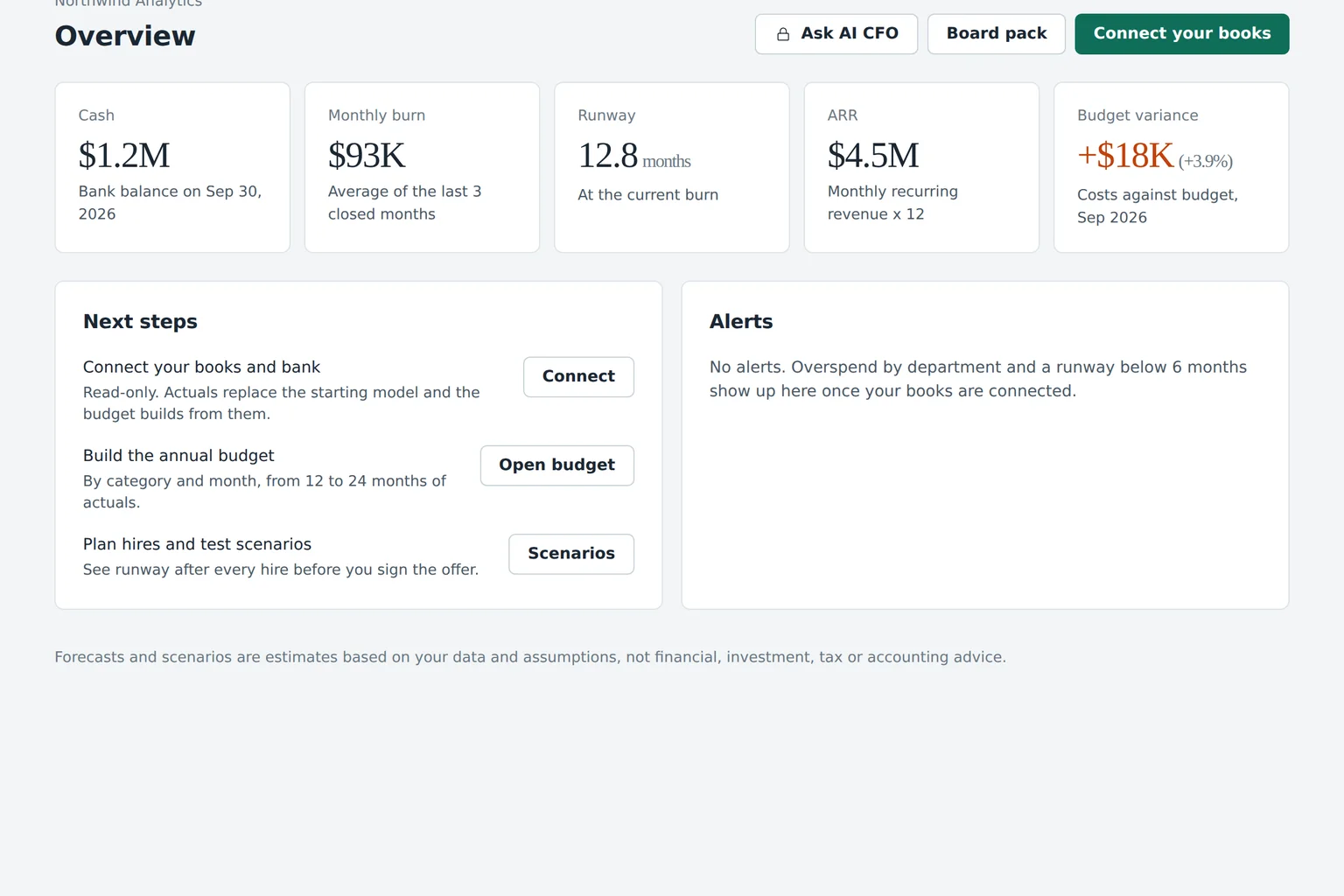
Example figures inside the product interface.
What FP&A software actually does
Financial planning and analysis is the work of deciding where the money goes next. The software is the system that keeps that work connected to the books.
Budget and forecast
An approved annual budget by account and month, with a forecast beside it that updates as actuals arrive. This is the core of every platform in the category, covered in detail on our page about budgeting and forecasting software.
Cash and runway
A short-term weekly cash view and a longer monthly one, with runway and the month cash would run out. For startups this is often the reason to buy in the first place.
Variance analysis
Budget vs actual and forecast vs actual by line and department, ranked by impact, so the monthly review starts with the gaps that matter.
Scenarios and drivers
What-if models for hiring, pricing, churn or a delayed raise, compared side by side before one of them becomes the forecast.
Headcount and revenue plans
Payroll planned by role and start date, and revenue planned from pipeline and recurring revenue data, both feeding the same forecast.
Reporting
KPI dashboards for the team and a board pack for investors, built from the same numbers, so nobody reconciles two versions of the truth.
How to know it is time to move off spreadsheets
Spreadsheets are a fine planning tool until they become a single point of failure. The question is not whether a spreadsheet can model your company. It almost always can. The question is how many hours a month it costs to keep it true and who can still maintain it.
If three or more of the signs on the right describe your current process, an FP&A platform will likely pay for itself in recovered time and fewer surprises.
- Actuals arrive by export and paste Every month someone copies data from the accounting system into the model and repairs the formulas that broke.
- Only one person understands the model When they are away, the forecast stops, and nobody else trusts their edits.
- Scenarios take days The board asks what happens if the raise slips six months and the answer arrives the following week.
- Department heads never see their budget Overspend is discovered after month close instead of during the month.
- Cash and profit live in different files The operating plan says one thing, the cash sheet another, and nobody is sure which is current.
- Several entities or currencies Consolidation by hand becomes the longest part of the month.
An FP&A software evaluation checklist
Use this list in every vendor conversation and every trial. A yes needs to be shown with your own data, not described on a slide.
Scroll sideways for all columns
| Criterion | What to ask | What a good answer looks like |
|---|---|---|
| Data connections | Which systems connect directly, and with what access? | Accounting, bank, payroll, CRM and revenue data, read-only, synced on a schedule |
| Time to first forecast | How long from signup to a budget built from our books? | Days at most, with your real chart of accounts |
| Budget and forecast versions | Can we keep the approved budget fixed while the forecast moves? | Yes, with version history and who approved what |
| Cash and runway | Do we get weekly and monthly cash views from the same model? | Yes, joined, with runway and cash-out month |
| Department ownership | Can owners see and approve only their lines? | Roles per department, alerts before overspend |
| Explanations | How does a non-finance leader ask a question? | Plain English answers that cite the numbers used |
| Pricing | What is the full price for our size, and does it change with users? | A published price you can check before any call |
| Security | How is our data stored and used? | Encrypted at rest and in transit, never used to train public models |
Read our security page for how Budgeter handles each point in the last row. For early stage companies, where runway and board reporting dominate the list, the guide to FP&A software for startups narrows the criteria further.
Implementation time is part of the price
The license is only the visible part of the cost. Many mid-market planning suites are introduced as a project, with a statement of work, a build phase in which the vendor or a partner recreates your model in their system, and training sessions before the first forecast is live. Those weeks consume your finance team's time, and the plan you needed for the current quarter is often still in a spreadsheet when the project ends.
Self-serve platforms take the opposite approach. You connect the accounting system, the software reads the history and drafts a budget and forecast, and you correct what it got wrong. The model is less bespoke on day one, but it is in use on day one. For a company of 30 people without a dedicated FP&A analyst, that difference usually decides the purchase.
What the first week with Budgeter looks like
- Day 1. Checkout, connect QuickBooks Online or Xero read-only, add a bank feed or Google Sheets. A draft budget and the 13-week and 12-month cash forecast appear after the first sync.
- Day 2. Review category mapping and fix the few accounts that landed in the wrong place. Set the growth and hiring assumptions that differ from history.
- Day 3. Approve the budget version and invite department owners as viewers or editors.
- Day 4 and 5. Build the first scenarios, set runway and overspend alerts and ask the AI CFO the questions the board usually asks.
What FP&A software costs
Prices below come from public pricing pages or from the absence of one. Where a vendor only quotes after a demo, we say so rather than guess.
Scroll sideways for all columns
| Option | Published price | How you buy | Best fit |
|---|---|---|---|
| Datarails, Cube, Abacum | Not published | Demo call, then quote | Mid-market planning teams |
| Jirav | Business plans 10,000 to 15,000 USD a year | Annual business plan | Driver-based planning, accounting firms |
| Fathom | 67 to 450 USD a month | Monthly per company bundle | Reporting and budget vs actual for accountants |
| LivePlan | 15 to 40 USD a month | Monthly plan | Business plans and simple forecasts for very small businesses |
| Fractional CFO | 3,000 to 10,000 USD a month | Engagement contract | Strategy, fundraising, investor relations |
| Budgeter.ai | 149 to 4,999 USD a month, half on yearly billing | Self-serve checkout, every plan | Companies of 5 to 500 people |
Across the category, dedicated FP&A platforms typically run from 10,000 to 150,000 dollars a year once implementation is included. That range reflects real capability for companies with complex consolidations and a team of analysts. For a company of 15 to 150 people it often means paying for a modeling environment nobody has time to maintain.
Budgeter sits between the small business tools and the suites. Small Business costs 149 dollars a month, or 74 a month billed yearly. Growth costs 599 dollars a month, or 299 yearly, and adds headcount and revenue planning, spend limits, KPI dashboards and the board pack. Scale at 1,999 dollars a month adds multi-entity consolidation, department approvals and a rolling forecast after close. Enterprise at 4,999 dollars a month adds SSO, SCIM and an SLA. Full details are on the pricing page.
Software or a fractional CFO
A fractional CFO at 3,000 to 10,000 dollars a month brings judgment, investor experience and negotiation that no software replaces. A year of Growth on yearly billing costs 3,588 dollars, about the price of one month of a fractional engagement at the low end.
The two are not either or. Scale includes client workspaces for up to five companies, so a fractional CFO can run the models for their clients in Budgeter and spend the saved hours on advice. Plain English questions to the AI CFO cover the routine requests between meetings.
Forecasts and scenarios are estimates based on your data and assumptions, not financial, investment, tax or accounting advice.
How to run an FP&A software evaluation
Running the evaluation this way keeps the decision about your planning process, not about the demo.
-
01
Write down the decisions
List the five decisions finance must support next year, such as hiring pace, fundraising timing or price changes. Features that serve none of them are noise.
-
02
Check your data sources
Confirm the tool reads your accounting system, bank, payroll, CRM and revenue data directly, read-only, without a monthly export.
-
03
Test with your own books
Connect real data and see whether a usable budget, cash forecast and variance report appear in days, not after a project.
-
04
Compare the full cost
Add license, implementation, internal time and any consultant hours for year one, then compare with the alternative of a spreadsheet or a fractional CFO.
If you want to test the forecasting engine before connecting anything, the runway calculator runs once on a few numbers you type in and returns an 18-month cash line, runway and break-even month.
Questions about FP&A software
Every Budgeter plan includes budgeting, cash forecasting, variance analysis, scenarios and the AI CFO.
What does FP&A software do?
FP&A software connects to your accounting and operational data and runs the planning cycle in one model, from the annual budget and rolling forecast to cash flow, scenarios, headcount and revenue plans, variance analysis and board reporting.
When does a company need FP&A software?
Usually when the spreadsheet model has several editors, the monthly close to review cycle takes more than a few days, or the board asks for scenarios and runway that take a week to rebuild. For many companies that happens somewhere between 20 and 100 people.
How long does FP&A software take to implement?
Mid-market suites are typically rolled out as a project of several weeks or months with a vendor or partner. Self-serve tools connect to your accounting system and produce a first budget and forecast in a working session. Budgeter is in the second group.
How much does FP&A software cost?
Mid-market FP&A platforms typically cost 10,000 to 150,000 dollars a year, and several vendors only quote after a demo. Budgeter publishes its prices, from 149 dollars a month on Small Business to 4,999 dollars a month on Enterprise, with 50 percent off on yearly billing.
Is FP&A software a replacement for a CFO?
No. Software does the data collection, modeling and reporting. A finance leader still sets strategy and negotiates with investors and banks. What changes is that a fractional or part-time finance lead spends their hours on decisions instead of rebuilding spreadsheets.
Does Budgeter replace my accounting software?
No. QuickBooks Online or Xero stay your system of record. Budgeter reads from them with read-only access and never writes back, so your books and your close process do not change.
Related planning modules
Evaluate FP&A software on your own numbers
Run the runway calculator once, then pick a plan at a published price and connect your books the same day.
Forecasts and scenarios are estimates based on your data and assumptions, not financial, investment, tax or accounting advice.