
Budgeting software for small business owners who want to stay ahead of cash
Budgeting software for small business turns your books into a monthly plan you can actually run the company on. Budgeter.ai reads QuickBooks or Xero, drafts a budget by category and month, keeps a cash buffer, owner pay and tax set-asides as separate lines, and emails you when a category runs over.
Read-only connections. Encrypted data. Cancel anytime.
Planned profit
$43.8k
before owner pay
Cash buffer
2.6mo
target 3.0
Tax reserve
$18.2k
year to date
Scroll sideways for all columns
| Budget line | Budget | Actual | Left |
|---|---|---|---|
| Retainer revenue | $118,000 | $118,000 | $0 |
| Project revenue | $34,000 | $27,500 | -$6,500 |
| Team payroll | $84,500 | $84,100 | $400 |
| Freelancers | $12,000 | $15,800 | -$3,800 |
| Software and tools | $4,200 | $3,900 | $300 |
| Rent and office | $7,500 | $7,500 | $0 |
| Owner pay | $14,000 | $14,000 | $0 |
| Tax set-aside, 25% | $7,450 | $7,450 | $0 |
Example figures inside the product interface.
Why a profitable small business still needs a budget
Small companies rarely fail at bookkeeping. They get surprised by cash, because profit on the income statement and money in the bank move at different speeds.
A 12 person agency can show a healthy profit in October and still struggle to pay quarterly tax in January. Clients pay on 45 day terms, a large project ends, two freelancers are booked for a pitch, and the owner draws the same salary as every month. None of that is visible in last month's profit and loss statement. It becomes visible only when someone puts next month's numbers on paper before the month starts.
That is all a budget is: a decision about what each month should look like, written down early enough to change course. For a small business the useful version is short. Revenue by stream, payroll, the three or four cost categories that move, rent, owner pay, a tax reserve and a target for the cash that stays in the bank. Twenty lines are usually enough.
What makes most owners give up is the upkeep. Every month someone exports actuals, pastes them into a sheet, fixes broken formulas and argues with last year's categories. Budgeter removes that work: actuals arrive from your accounting system on each sync, and the budget compares itself with them. You spend the monthly review deciding, not reconciling, and the budget vs actual view is ready the moment the books close.
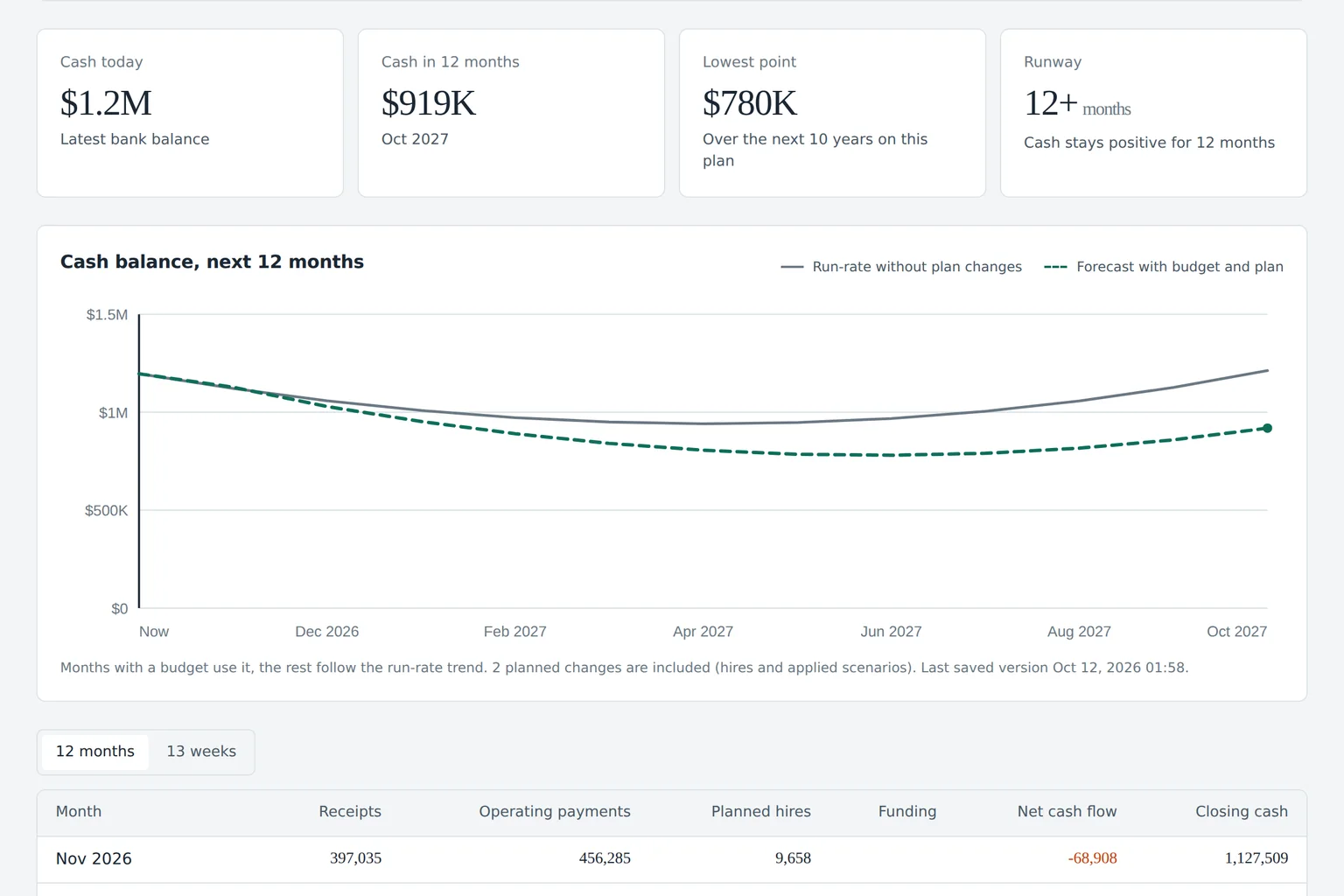
The same data feeds a 13-week and a 12-month cash forecast. If a slow month is coming, you see it about a quarter ahead, which is the window in which a small business can still move a payment date, chase an invoice or delay a purchase. For a longer view of cash, read how our cash flow forecasting software builds the weekly projection.
Owner pay and tax set-asides belong in the budget
The most common small business budgeting mistake is treating the bottom line as money the owner can spend. Three lines fix it.
Owner pay
A fixed monthly amount, budgeted like any salary. Profit above it stays in the company until you decide otherwise.
Tax reserve
A percentage of profit that you and your accountant agree on, moved into its own line every month so the bill is never a surprise.
Cash buffer
A target expressed in months of fixed costs, often two to three, with the forecast showing when you reach it.
Budgeter does not decide these amounts and does not give tax advice. It keeps them visible. When the plan shows a 25 percent tax set-aside, the monthly view shows what has been reserved so far, and the AI CFO can answer questions such as "what is left for a bonus in December after tax reserve and buffer" in plain English, with the figures it used.
A worked example for a 12 person agency
Here is a hypothetical 12 person design and development agency planning its next quarter. Retainers are steady, projects are lumpy and freelancers fill the gaps.
Scroll sideways for all columns
| Line | January | February | March | Note |
|---|---|---|---|---|
| Retainers | $118,000 | $118,000 | $124,000 | One retainer grows in March |
| Projects | $22,000 | $30,000 | $41,000 | Two projects start in Q1 |
| Team payroll and benefits | $84,500 | $84,500 | $84,500 | No new hires planned |
| Freelancers | $9,000 | $12,000 | $16,000 | Follows project volume |
| Software, rent, other | $15,200 | $14,700 | $14,900 | Annual tools renew in January |
| Owner pay | $14,000 | $14,000 | $14,000 | Fixed |
| Tax set-aside, 25% | $4,325 | $5,700 | $8,900 | Of profit after owner pay |
| Into cash buffer | $12,975 | $17,100 | $26,700 | Buffer reaches 3 months in March |
January is the thin month. Annual software renews, projects are still in proposal and the tax reserve is small because profit is small. The owner knows this in December, not on January 20, and can ask the main retainer client to pay the January invoice early or move a tools renewal to monthly billing.
By March the buffer reaches its three month target, and the question becomes what to do with the surplus. A scenario such as "hire a senior designer in April at 95,000 dollars a year" shows the effect on cash and on the buffer before anyone signs an offer. The Small Business plan keeps five saved scenarios side by side.
Forecasts and scenarios are estimates based on your data and assumptions, not financial, investment, tax or accounting advice.
How it works
Budgeter is set up in an afternoon. You connect, review a draft and adjust the handful of lines that only you know.
-
01
Connect two sources
Link QuickBooks Online or Xero read-only, plus one of your bank feed, Stripe revenue data or a Google Sheet you already keep.
-
02
Get a budget from your history
Budgeter reads 12 to 24 months of actuals and drafts next year by category and month, including the seasonal dips you already know about.
-
03
Add the owner lines
Set owner pay, a tax set-aside percentage and a cash buffer target as their own budget lines, so profit is not mistaken for spare cash.
-
04
Review once a month
After each close you see the month against plan, the 13-week cash view and an email if any category ran over.
What the Small Business plan includes
The Small Business plan is $149 a month, or $74 a month billed yearly at $888. Yearly billing saves 50 percent. Every price is on the pricing page and checkout is self-serve.
- Two integrations QuickBooks Online or Xero, plus your bank feed, Stripe revenue data or Google Sheets.
- Annual budget from your actuals Drafted from 12 to 24 months of history, by category and month.
- Cash forecast 13-week and 12-month views, refreshed on each sync, up to 24 months ahead.
- Monthly overspend alerts An email when a category finishes the month above plan.
- Five saved scenarios Test a hire, a price change or a slow quarter before deciding.
- AI CFO chat 100 questions a month, answered with runway, break-even and cash needed.
- People One entity, three editors and unlimited read-only viewers.
- Exports PDF and CSV for your accountant or your bank.
Spreadsheet or planning tool or Budgeter
There is no single right tool. The honest answer depends on how much of your week the numbers take today.
Scroll sideways for all columns
| Question | Spreadsheet | Business plan tools | Budgeter.ai |
|---|---|---|---|
| Monthly price | Nothing extra | About $15 to $40, for example LivePlan | $149, or $74 billed yearly |
| Where actuals come from | You export and paste | Accounting sync in some tools | Read-only sync from QuickBooks or Xero |
| Cash forecast | Built and kept by you | Simple forecast | 13-week and 12-month, refreshed on sync |
| Owner pay and tax reserve | Any line you add | Depends on template | Dedicated budget lines with running totals |
| Overspend notice | When you look | Varies | Email after the month that shows it |
| Plain English answers | No | No | AI CFO, 100 questions a month |
A spreadsheet is the right answer for a very small company with one revenue stream and an owner who enjoys the work. Business plan tools such as LivePlan, listed at roughly 15 to 40 dollars a month, are good at writing a plan for a loan or a first year. They are built around simple forecasts for tiny businesses.
Budgeter costs more because it does the monthly upkeep: synced actuals, cash forecast, alerts and an assistant that explains the numbers. Compared with a fractional CFO at 3,000 to 10,000 dollars a month, it covers the routine part of the job and leaves the judgment calls with you and your accountant.
Questions from small business owners
Want to see your own numbers first? The runway calculator takes five inputs and needs no account.
Who is the Small Business plan built for?
Owners and operators of profitable companies with roughly 5 to 50 people, such as agencies, online stores and clinic groups, who want a monthly budget and a cash forecast without hiring a finance team. It covers one entity, three editors and unlimited read-only viewers.
Does Budgeter tell me how much tax to set aside?
No. You choose the percentage, usually with your accountant, and Budgeter turns it into a monthly budget line and tracks the balance you have reserved. It does not give tax advice or calculate what you owe.
Can I keep using my spreadsheet?
Yes. Google Sheets is one of the supported read-only sources, so a sheet with sales targets or a staffing list can feed the budget. Many owners keep a sheet for notes and let Budgeter handle actuals and the cash forecast.
What does the Small Business plan cost?
It is $149 a month on monthly billing or $74 a month on yearly billing, which is $888 billed once a year. Yearly billing saves 50 percent. Checkout is self-serve and you can cancel at any time.
What do I get when I outgrow it?
The Growth plan adds headcount and revenue planning, spend limits per department and vendor, a board pack, KPI dashboards and 600 AI CFO questions a month. You can switch plans from the billing page.
Put your next twelve months on one page
Run a quick runway forecast from a few numbers, then connect your books to get a monthly budget with owner pay, tax reserve and cash buffer built in.
Forecasts and scenarios are estimates based on your data and assumptions, not financial, investment, tax or accounting advice.